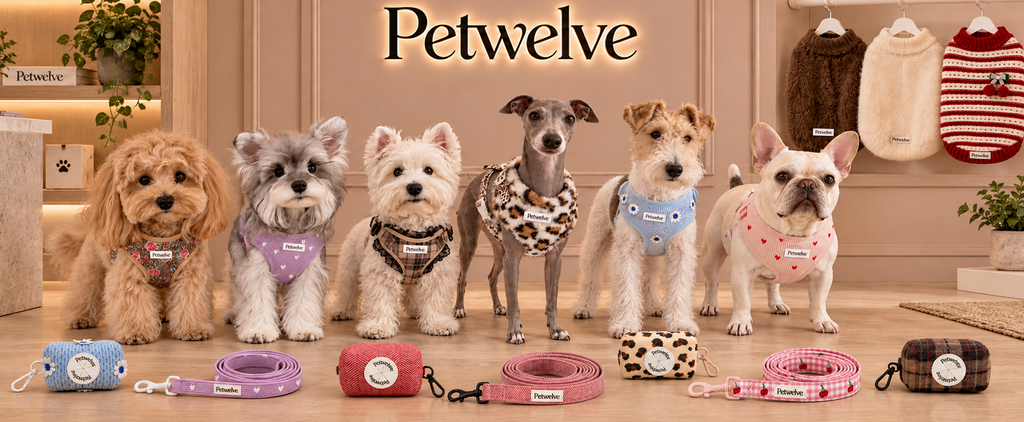
You only need one number to get a harness size right: your dog’s chest girth. Measure the widest part of the chest, just behind the front legs, with a soft tape held snug — then match that number to the size chart on the product page. Neck length matter too if you’re buying a vest-style or step-in harness, which is why we measure all two below.
A harness that fits well is safer, lasts longer, and stops the rubbing that makes dogs refuse to wear it. Here’s the full routine we recommend to every Petwelve customer.
What you need before you start
- A soft measuring tape (a tailor’s tape; if you don’t have one, use a piece of string and measure it against a ruler)
- A few treats to keep your dog standing still
- Your dog standing on all four legs on a flat surface — not sitting, not lying down
Get the treats ready first. A dog that stands calmly for 30 seconds is easier to measure accurately than one that’s wriggling to get away.
Step 1: Measure chest girth (the deciding number)
- Find the widest part of the ribcage, just behind the front legs.
- Wrap the tape all the way around in a full circle.
- Pull it snug — not tight. Two fingers should fit flat under the tape.
Write this number down in centimetres and inches. Chest girth is the measurement nearly every harness size chart is built on, so if you only measure one thing, measure this.
Tip: measure twice. If the two numbers differ by more than 1 cm, your dog moved — reset and try again.
Step 2: Measure neck circumference
Wrap the tape around the base of the neck, where a collar naturally sits, and record the snug measurement. Neck size matters most for step-in and over-the-head harnesses, where the opening has to pass over the head comfortably.
Quick reference: typical size bands
Use this as a starting point only; always confirm against the specific product’s size chart.
| Neck(in) | Chest(in) | Weight(lbs) | |
| XS | 11.4-14.2 | 13.8-18.9 | under 11 |
| S | 13.78-16.92 | 16.14-21.25 | 11-28.6 |
| M | 15.35-19.68 | 18.11-23.62 | 22-37.5 |
| L | 16.53-21.65 | 22.44-31.5 | 30.8-66 |
Two dogs at the same weight can have very different chests — a deep-chested breed and a slim breed rarely share a size. Trust the tape, not the breed label.
If your dog is between two sizes
Size up. A harness that is one size too large can be tightened at the straps; one that is too small cannot be loosened, and it will rub the armpits on longer walks. When in doubt, choose the larger size and adjust the straps down.
The 2-finger fit check (do this after it arrives)
Put the harness on and check all four points:
- Two fingers under every strap. If you can’t fit two fingers flat under the chest strap, it’s too tight. If your whole hand slides under, it’s too loose.
- No slipping. Gently pull backwards on the harness — it should not slide off over the shoulders.
- Full shoulder movement. Ask your dog to walk a few steps. The front legs should move freely with no fabric bunching behind the elbow.
- D-ring position. The leash attachment should sit on the back, level with the shoulder blades, not down near the tail.
If any point fails, adjust the straps and repeat. Most “bad” harnesses are simply badly adjusted ones.
Common measuring mistakes
- Measuring loosely. A tape hanging slack can add 3–5 cm, which is often a whole size.
- Using a collar size for a harness. Collar sizes are based on the neck only and don’t reflect chest girth.
- Measuring over a thick winter coat. Measure your dog’s body, then allow room for clothing if you plan to layer.
- Skipping re-measurement for puppies. Puppies can change size every 3–4 weeks. Re-measure monthly until they’re fully grown.
When to re-measure
Re-measure your dog if you notice any of these: the harness leaves marks after a walk, your dog stops to scratch at the chest strap, the fit changes after a groom or a seasonal coat change, or your dog has gained or lost weight. A five-second tape check saves a return.
Wrap a soft tape around the widest part of the chest just behind the front legs, hold it snug with two fingers fitting flat underneath, and record that number. Match it to the size chart on the product page.
Choose the larger size and tighten the adjustable straps. A slightly large harness can be adjusted; a small one will be uncomfortable and rub.
Both. Chest girth determines the main size. Neck measurement matters for step-in and over-the-head styles that pass over the head.
Once a year for adult dogs, and monthly for puppies until they finish growing. Also re-measure after major weight changes or a heavy seasonal coat.
No. Collar size is based on the neck alone. Harness sizes are built on chest girth, which is usually several centimetres larger.
Ready to size it right? Browse the Petwelve harness collection — every product page carries its own chest girth chart — or start with our most adjustable fits: the Herringbone Tweed 3-in-1 set and the Pink Gingham no-pull mesh vest.
For puppy first-timers, the 3-in-1 zoo animal set comes with an adjustable strap range that covers the first few growth spurts.